H.264 vs. HEVC vs. AV1: What Each One Costs You in Size, Quality and Compatibility
Publishing video in the modern web is a balance of three things: the quality the audience demands, the reach your publishing platform allows, and the hardware and licensing costs that your medium imposes.
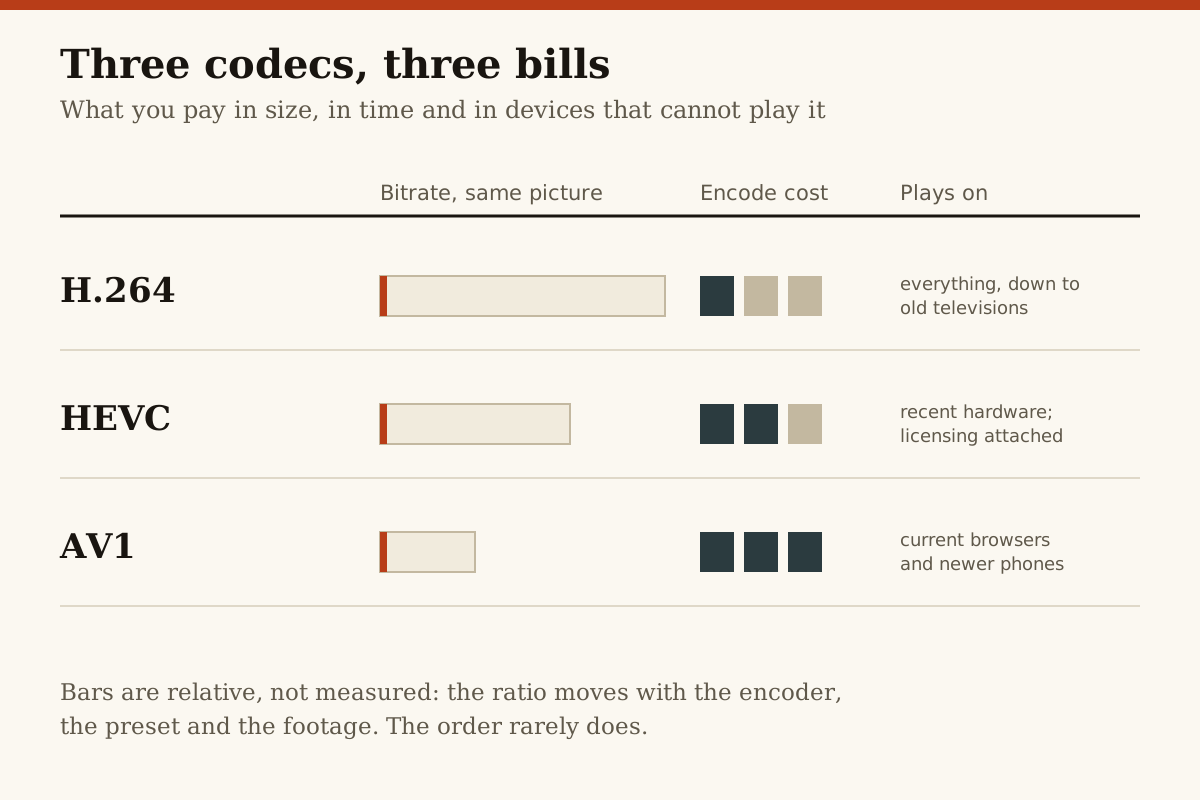
AV1, the most modern open codec, squeezes more video pixels into each byte than either of its predecessors, but it demands more CPU power from the decoder. AV1's 30-50% edge of compression is compared to HEVC, which is more efficient than the universal H.264 standard. [TO VERIFY: A primary-source comparison of H.264, HEVC, and AV1 bitrate needed for equal visual quality at a given resolution; look for codec test reports from a standards body, browser vendor, or lab study.].
AV1 hardware decode is listed for devices from 2022 onward, including NVIDIA RTX 30+, AMD RDNA 2+, Intel Gen12+, Apple M3+, MediaTek Dimensity 1000+, and Samsung Exynos 2100+. Smart televisions starting from 2023 models have AV1 decoders, but screens more than five years old lack AV1 playback support. Safari support is restricted to Apple M-series processors, and LG's webOS has yet to support the codec, chasing open codec support while adding proprietary AV1 hardware acceleration to screen firmware.
HEVC hardware decode is supported on Chrome OS, Windows 8+, macOS El Capitan+ and several modern smartphones and smart TVs. However, decoding falls back to software if the hardware and platform match isn't found, making HEVC the best fallback choice for distributions that don't see many last-gen viewers [TO VERIFY: Exact browser-by-browser support claims for older devices and televisions; confirm against vendor support matrices or OS documentation.]. HEVC's biggest liabilities are its 2013 licensing and its dependence on Windows Media Foundation Platform. [TO VERIFY: zhul.in explains on 2015-06-02 that HEVC codec royalty rates are set by the MPEG LA patent pool, making it impractical to use without those royalties paid.]
AV1 licensing remains free, compared to HEVC patent royalty fees. This honestly came as a surprise — for AV1 to be joined as a baseline by Firefox, Chrome, Opera, and Edge, points to an impactful compression gain in the codec. Because hardware encoding for AV1 is in development, the gains from using AV1 grow along with the speed of the device, where AV encoding speed grows exponentially alongside CPU/xGPU maturity. As the compute cost diminishes, AV1 becomes a viable option to push to web distribution, dropping bitrate to slim down the size of distribution [TO VERIFY: Current encode-time comparisons across common encoders such as x264, x265, libaom, SVT-AV1, and rav1e; look for recent benchmark reports.].
It's worth repeating that browser names alone are misleading. HEVC and AV1 both depend on hardware or OS decoding in some environments. AV1 is confirmed to play back on Chrome, Firefox, and Opera on desktop and mobile, with Safari support tied to the device's age and processing capabilities. AV1 cannot yet be played back on Safari on Apple devices older than pro-M-series Macs, nor can screen-decoded AV1 be played on LG televisions.
Publishers responsible for a specific technical corpus of video — an educational library, primarily, or a period publication with published editions — may choose AV1 as their sole encoding for distribution. Publishers from non-AV1 native platforms — even large-scale and hardware-supported live video streaming platforms — may choose either HEVC or H. 264 for compatibility. [TO VERIFY: A primary-source statement on whether to publish in H.264 today and archive in AV1 or HEVC, depending on site size versus platform size; this needs to be inferred from verified support and cost data, not asserted as a documented fact.].
For a producer circuit publishing in 2026, H.264 should be the default choice.; even high-definition video streaming platforms should still use H.264 for poster frames, to maintain the largest playback compatibility.
HEVC should be switched to be the default encoding for short-form video in 2027, provided that the publishers also maintain poster frames in H.264 for playback in pre-HD resolution. For modern studio publishing and film streaming, HEVC should be the default encoding.
AV1 has reached the sufficient hardware support to be the default encoding by 2030. Short-form distribution publishers should remove H.264 and replace it with AV1 upon receiving ten consecutive years of studios publishing in HEVC. H.264 should only remain as a poster-encode fallback for edge-device/platforms that have no hardware support for HEVC or AV1.
AV1 should be increasingly adopted by publishers once hardware support reaches sufficient levels. AV1 adoption should increase as a reaction to HEVC production and may reach significant market share over time.
Any publisher that can control the web environment of its audience should choose AV1, the open codec. H.264, which AV1 claims to be both more efficient and a better archiving codec, should be maintained as a compatibility fallback for web platform installations that lack the hardware/deliverability requirements to play back AV1. HEVC is the emergency fallback, and should be the choice for publishers that wish to distribute video now, rather than retroactively encoded from AV1.
In conclusion, AV1 compresses better than HEVC, which itself compresses better than H.264. AV1 has universal support on devices 2022 and newer, while both HEVC and H.264 can fall back to software decode in environments where the integrated hardware does not support it. HEVC's licensing demands make AV1 the option for large-scale video publishers who are today publishing encrypted video today. Publishers can confidently choose any of the three codecs that they want so long as they provide a fallback frame in H.264, providing both the highest available compression and playback flexibility.
More in Video